
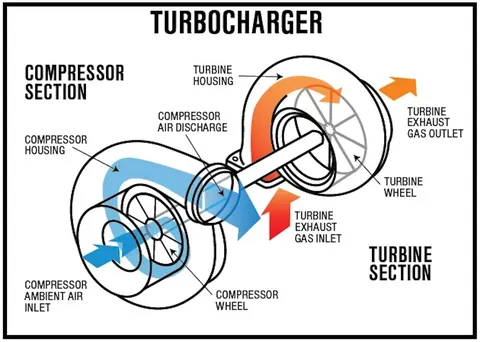
If you are looking to learn what is inducer in turbocharger design, it is the smaller, inlet portion of the compressor wheel. It sucks ambient filtered air parallel with the driven shaft, compresses it, and pushes it out through the exducer section.
The smaller side of the compressor wheel, which is the inlet side or front, is this specialized entry section.
To direct the flow of fresh air towards the center, this component made of light alloy aluminum steel is fitted just before the impeller.
The main functions of this inlet section in a turbocharger are:
- To feed shockless airflow to the impeller of the turbocharger.
- To boost atmospheric air to a higher pressure.
- To guide the air smoothly into the eye of the impeller.
Inducer vs Exducer in a Turbocharger
To fully answer what is inducer in a turbocharger, it is helpful to compare it to the exducer. The inducer section is where air enters the compressor wheel, featuring a smaller diameter designed to swallow ambient air. In contrast, the exducer is the larger diameter section where the air exits the wheel at high pressure. This design allows the turbocharger to compress air efficiently before feeding it to the engine cylinders.
The inducer diameter is defined as the diameter where the air enters the wheel, whereas the exducer diameter is defined as the diameter where the air exits the wheel. Based on aerodynamics and air entry paths, the entry portion for a compressor wheel has a smaller diameter.
Discussion & Feedback
0Have a doubt, memory trick, or exam update? Share your insights with fellow mariners.