
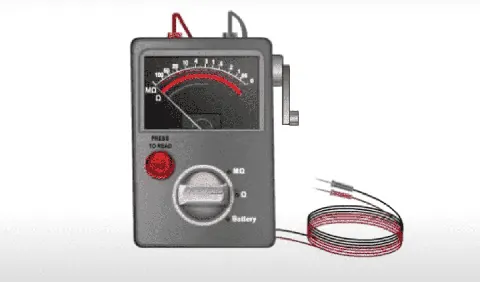
If you are wondering what is megger in electrical systems, here is the answer. A megger (with the literal megger meaning being a mega-ohm meter) is an instrument used for insulation testing. It measures the unknown resistance of electrical insulation by applying a high test voltage. It is a combination of both a generator and an ohmmeter, used to measure the high-value resistance (IR value).
Principle of Megger:
Megger works on the principle of Electromagnetic Induction. The operation of a megger is based on a moving coil meter. When current is flowing in a conductor, which is placed in a magnetic field, it experiences a torque.
Types of Megger:
- Electronic Type (Battery Operated)
- Manual Type (Hand Operated)
Megger Working Principle & Insulation Testing
The megger working principle is based on electromagnetic attraction. The device uses a hand cranked dc generator to supply the test voltage. When testing a cable or motor, the guard terminal prevents leakage current from affecting the measurement. In a short circuit condition, the needle drops to zero. This makes the insulation resistance test very reliable.
Working of Megger (Diagram & Drawing):
Below is a detailed megger diagram and megger drawing that shows the internal connections of the voltage coil and current coil in a manual megger meter diagram.
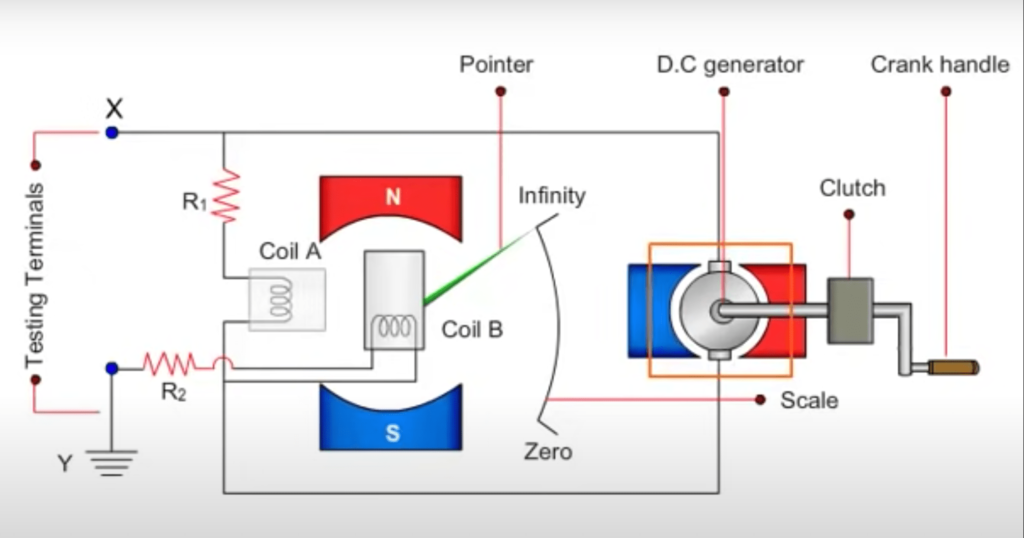
The armature of the generator is rotated by the hand-driven crank lever. The clutch mechanism is designed to slip at a predetermined speed. This facilitates the generator to maintain a constant speed and hence the constant voltage while testing.
The two coils a and B constitute a moving coil voltmeter and an ammeter both are combined to form one instrument.
The hot terminal of the equipment whose insulation resistance has to be measured is connected to the testing terminal X, the terminal Y is connected to the body of the equipment which is generally grounded.
When the crank handle is rotated, a voltage is generated in the generator. The generated voltage is applied across the voltage coil A through a resistance R1.
When the terminals X and Y are free initially, no current flows through coil B. The torque produced by coil A rotates the moving element to show infinity.
While testing, the terminals X and Y are connected across the terminal and body of the machine for measurement. Now the current passes through the deflecting coil B. The deflecting torque produced by coil B interacts with the torque of coil A and rotates the moving element to indicate the resistance valve.
The voltage generated by this instrument is around 500 volts. Meggers are available to generate 1000 volts, 2500 volts, and 5000 volts also.
High voltage meggers are either motor-operated or power-operated
Uses of Megger on Ship
The Megger enables us to measure electrical leakage in wire, results are very reliable as we shall be passing an electric current through the device while we are testing. The equipment basically used for verifying the electrical insulation level of any device such as motor, cable, generator winding, etc
It is used to test the resistance of
- Cable Insulation Resistance.
- All Motors, generators, and transformers winding's insulation resistance.
- All semiconductor devices when reverse biased.
What is the use of megger?
What is the acceptable Megger reading for a motor?
Discussion & Feedback
0Have a doubt, memory trick, or exam update? Share your insights with fellow mariners.