
Table of Contents (20)
Anyone who has spent an afternoon in 45°C engine-room heat hauling out a 50-kilogram sea chest strainer basket choked with mussels and rotting black sludge knows how fast marine biofouling can cripple a vessel.
When you are steaming through tropical waters like the Malacca Strait, the Persian Gulf, or the Caribbean, seawater temperatures often sit above 30°C. Your central coolers and jacket water heat exchangers are already working near their thermal design limits. If marine organisms start settling in your sea chest strainers and colonizing the piping, water flow drops, your main engine scavenge air temperature creeps up into the warning zone, and the watchkeeping team is faced with an engine slowdown or an emergency mid-voyage strainer clean.
That is why commercial vessels are fitted with an MGPS (Marine Growth Prevention System). Whether your ship carries a system from Cathelco, KC Ltd, or Wilson Taylor, understanding how it works, how to log its parameters properly, and how to troubleshoot its alarms is essential watchkeeping knowledge for every marine engineer.
1. What Happens Inside an Unprotected Sea Chest?
The external grating on a ship’s sea chest has slots roughly 10 to 15 mm wide. While that keeps out plastic bags, jellyfish, and driftwood, it does nothing to stop microscopic larvae, barnacle cyprids, mussel spat, and hydroid spores from being sucked right into the cooling intake.
Once inside your vessel’s pipework, these organisms enter what is essentially a luxury resort:
- Constant Food Supply: Hundreds of cubic meters of fresh seawater rushing past every hour, loaded with plankton and organic nutrients.
- Sheltered Warmth: Engine room ambient heat and warm heat-exchanger discharge pipes create an ideal incubation temperature.
- Zero Predators: No fish or crabs can survive the suction currents to feed on them.
Incoming Seawater (Larvae & Spores)
               │
               ▼
┌────────────────────────────────────────┐
│ 1. The Slime Layer (Micro-Fouling)     │ ──> Bacteria & diatoms form a sticky, slippery
│    Forms within hours on bare metal    │     slime film that coats pipe interiors.
└──────────────────┬─────────────────────┘
                   │
                   ▼
┌────────────────────────────────────────┐
│ 2. Colonisation (Macro-Fouling)        │ ──> Barnacle larvae & mussel spat anchor down
│    Hard shells cement to pipe surfaces │     using biological cement, drawing calcium to grow.
└──────────────────┬─────────────────────┘
                   │
                   ▼
┌────────────────────────────────────────────────────────────────────────┐
│ Operational Fallout:                                                   │
│ • Central fresh water & lube oil coolers overheat                      │
│ • Sea water pump suction chokes, causing severe cavitation & seal leaks│
│ • Anaerobic bacteria under shells cause Microbially Influenced         │
│   Corrosion (MIC), pitting pinholes through pipe elbows at sea         │
└────────────────────────────────────────────────────────────────────────┘
Within a few short weeks, a thin biofilm turns into thick, crusty mats of barnacles and blue mussels. The practical consequences hit every watch:
- Severe Heat Exchanger Starvation: A biological slime layer just 1 mm thick acts as a thermal insulator, cutting heat transfer across titanium plates by up to 30%. Your fresh water cooling temperatures rise, lube oil coolers struggle, and air compressors overheat.
- Pump Cavitation and Impeller Erosion: As the strainer basket holes clog, suction pressure drops into a vacuum. The main seawater circulating pump starts rattling like a coffee can full of bolts, eating away the bronze impeller vanes through cavitation.
- Microbially Influenced Corrosion (MIC): Barnacles do not just block flow; their bases seal off tiny areas of metal from oxygen. Anaerobic sulfate-reducing bacteria thrive underneath, generating localized acidic pockets. This produces aggressive pitting corrosion, eating pinholes straight through carbon steel and galvanized pipe elbows.
2. How the Electrolytic MGPS Works
While chemical dosing (sodium hypochlorite) and acoustic pulse transducers exist, 95% of merchant vessels use electrolytic MGPS systems.
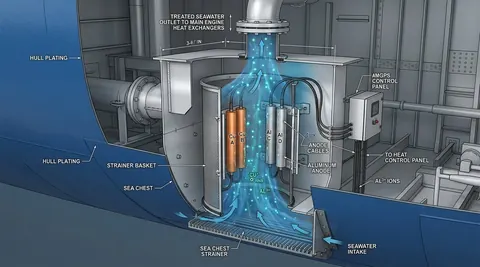
The system uses consumable metal rods (anodes) bolted through the top or side of the sea chest or inside the seawater strainer casing. These anodes are connected to a direct current (DC) power unit mounted in the engine room.
       ┌────────────────────────────────────────────────────────┐
       │                 MGPS DC CONTROL PANEL                  │
       │           (Cathelco / KC Ltd / Wilson Taylor)          │
       └────────────────────────────────────────────────────────┘
                   │ (+) Positive Anode Leads
                   ▼
┌──────────────────────────────────────────────────────────────────────┐
│                            SEA CHEST                                 │
│                                                                      │
│    ┌───────────────┐                  ┌─────────────────────────┐    │
│    │ COPPER ANODE  │                  │ ALUMINUM / IRON ANODE   │    │
│    │     (Cu)      │                  │       (Al or Fe)        │    │
│    └───────┬───────┘                  └────────────┬────────────┘    │
│            │                                       │                 │
│            ▼                                       ▼                 │
│         Cu²⁺ Ions                               Al³⁺ Ions            │
│            │                                       │                 │
│            │                                       ▼                 │
│            │                             Al(OH)₃ Hydroxide Floc      │
│            │                                       │                 │
│            └───────────────────┬───────────────────┘                 │
│                                │                                     │
│                                ▼                                     │
│           ┌─────────────────────────────────────────────┐            │
│           │ TREATED SEAWATER CIRCULATING THROUGH SHIP   │            │
│           │ • Cu²⁺: Stopps larvae from adhering         │            │
│           │ • Al(OH)₃: Coats pipe bore against corrosion│            │
│           └──────────────────────┬──────────────────────┘            │
└──────────────────────────────────┼───────────────────────────────────┘
                                   │
                                   ▼
                To Main Central Coolers, Condensers & Pumps
The Dual-Action Anode Pair
An electrolytic MGPS always pairs two distinct metals together because it handles two separate jobs: anti-fouling and anti-corrosion.
1. The Copper Anode (Cu) — The Larvae Deterrent
The control panel sends a low impressed direct current through the copper anode. In seawater, the copper oxidizes:
Cu ⟶ Cu²⁺ + 2e⁻The system is calibrated to produce a copper concentration of roughly 2 parts per billion (2 ppb, or 2 µg per liter).
At 2 ppb, the copper does not act as a massive toxic poison that kills the sea; it simply irritates the settling larvae and disrupts their protein-bonding cement. Unable to anchor themselves to the slick pipe walls, the larvae and algae spores drift straight through the strainers, heat exchangers, and overboard discharge valves without sticking.
2. The Aluminum Anode (Al) — The Pipe Protector
Next to the copper anode sits an aluminum anode connected to the same control unit:
Al ⟶ Al³⁺ + 3e⁻In the alkaline seawater environment, these aluminum ions react immediately with naturally occurring hydroxyl ions:
Al³⁺ + 3OH⁻ ⟶ Al(OH)₃ ↓This reaction creates a gelatinous precipitate known as aluminum hydroxide floc. As this floc travels with the cooling water, it deposits a microscopic, alkaline film along the inner surface of your steel and galvanized pipework. This protective barrier separates bare metal from dissolved oxygen and harsh chloride ions, drastically slowing down internal corrosion and erosion.
3. When Do Ships Use Iron Anodes Instead of Aluminum?
This is one of the most common oral examination questions for 4th and 2nd Engineers:
Why are some ships fitted with soft iron anodes instead of aluminum?
The answer comes down to pipe metallurgy:
- Carbon Steel & Galvanized Steel Lines: Fitted with Copper + Aluminum anodes. The aluminum hydroxide film coats the steel effectively.
- Cupro-Nickel (Cu-Ni 90/10 or 70/30) Lines: Fitted with Copper + Soft Iron (Ferrous) anodes.
On LNG carriers, passenger vessels, and modern container ships with high-grade copper-nickel piping, aluminum hydroxide floc can interfere with the copper-nickel alloy’s natural passive film. Instead, soft iron anodes release ferrous ions:
Fe ⟶ Fe²⁺ + 2e⁻These iron ions form a tough, protective lepidocrocite layer (γ-FeOOH) over the cupro-nickel surfaces. This layer is exceptionally durable and protects pipe bends, elbows, and crossover lines from impingement attack and cavitation erosion caused by turbulent water flow.
4. Hardware Anatomy & Sea Chest Mounting
To replace or inspect an MGPS during dry dock, you need to understand how the physical hardware penetrates the ship’s hull:
                  ┌─────────────────────────────┐
                  │ 1. MGPS Control Unit        │
                  │    • 220V AC input          │
                  │    • Constant DC Amps out   │
                  │    • Ammeter & Voltmeter    │
                  └──────────────┬──────────────┘
                                 │ Marine armoured cable
                                 ▼
                  ┌─────────────────────────────┐
                  │ 2. Cofferdam Junction Box   │
                  │    • Watertight terminal box│
                  │    • Mounted on tank top    │
                  └──────────────┬──────────────┘
                                 │
         ┌───────────────────────┴───────────────────────┐
         ▼                                               ▼
┌─────────────────┐                             ┌─────────────────┐
│ Copper Anode    │                             │ Al / Fe Anode   │
│ Sleeve & Flange │                             │ Sleeve & Flange │
└────────┬────────┘                             └────────┬────────┘
         │                                               │
═════════╪═══════════════════════════════════════════════╪════════  <-- Sea Chest Top Plate
         │           ┌───────────────────────┐           │
         └──[Anode]──│  SEA CHEST INTERIOR   │──[Anode]──┘
                     │  & STRAINER BASKET    │
└───────────────────────┘- The Cofferdam Sleeve: Because the anode penetrates the vessel’s hull boundary, classification societies mandate that it sits inside a certified watertight steel cofferdam. If an external seal leaks, water is contained inside this sleeve rather than flooding the engine room bilges.
- Dielectric Insulating Bushings: The anode must be electrically isolated from the sea chest steel plate, otherwise current would short directly to the hull without passing through the seawater. PTFE or neoprene insulating sleeves and washers isolate the mounting studs.
- The Rubber Shrink Boot: The top 50 to 100 mm of the anode rod (where it threads into the mounting sleeve) is wrapped in a thick, vulcanized rubber or epoxy boot. This forces the electrical current to discharge only from the lower half of the rod sitting in the rushing water. Without this boot, the anode would dissolve rapidly right at the threaded neck, snapping off in heavy seas.
5. Daily Watchkeeping: What to Check and How to Log
During your morning 8-12 or 4-8 watch rounds, checking the MGPS panel should be an automatic habit:
1. The Normal Reading
A properly functioning Cathelco or KC control panel operates in Constant Current mode.
- Current (Amps): Should match the maker’s operating manual setting (typically 2.0 to 4.5 Amperes per anode, depending on sea chest size and water flow).
- Voltage (Volts): Should read between 2.0 V and 6.0 V DC.
2. Reading the Voltage Trends
The voltage tells you what is physically happening inside the sea chest:
- Gradual Voltage Rise (Over Months): As the anode rod wears away, its surface area shrinks, increasing electrical resistance. A gradual climb from 3.0 V to 5.5 V over six months is completely normal and shows the anode is being consumed properly.
- Sudden Jump to Maximum Scale (8.0 V to 12.0 V / Open Circuit Alarm): The circuit is broken. Either a cable wire has come loose in the cofferdam junction box, or the anode has snapped off at the neck and fallen to the bottom of the sea chest.
- Sudden Drop to Near Zero (< 0.5 V / Earth Fault Alarm): A dead short circuit. Either a piece of wire or metal debris is bridging the anode to the sea chest grating, or the insulating PTFE bushing has cracked and water has shorted the terminal stud to the hull.
3. Sea Mode vs. Port Mode (Don’t Over-Dose in Port)
- At Sea (High Flow): When steaming at 15–20 knots, thousands of tons of seawater pass through the cooling system every hour. The panel must output full rated current to treat that massive volume.
- In Port (Low Flow): When tied to the berth, only one auxiliary generator and the auxiliary condenser are running. Flow drops by 80%. If you leave the MGPS at full sea rating, heavy copper and aluminum sludge will settle in your dormant chests and stainers.
- Modern panels hook up to pump run signals or NMEA GPS speed inputs to step down automatically. If your ship has a manual panel, the watch engineer must remember to toggle the switch to Port Mode once the vessel is finished with engines (FWE).
4. The Low-to-High Sea Chest Transfer Procedure
When transitioning from open deep water to shallow river transit (like steaming up the Yangtze or the Mississippi River), the bridge will order a changeover from the Low Sea Chest to the High Sea Chest to avoid sucking in riverbed silt:
- Crack open the High Sea Chest suction valve and verify water pressure on your sea water pump gauges.
- Slowly close the Low Sea Chest suction valve.
- Immediately flip the MGPS selector switch on the control panel to HIGH CHEST.
- Check that current is flowing on the High Chest ammeter and that voltage stabilizes between 2 and 6 V.
Why this matters: If you forget step 3, current keeps flowing to the Low Chest where the water is completely stagnant, boiling chemicals locally. Meanwhile, your active High Sea Chest receives zero treatment, letting river organisms enter your coolers unhindered.
6. Real Shipyard Gotchas: What Can Go Wrong in Dry Dock
Dry dock is when anodes are inspected and renewed, but it is also where the most avoidable blunders happen:
Gotcha 1: Shipyard Painters Coating the Anodes
This happens more often than anyone likes to admit. The shipyard grit-blasts the sea chest and sprays two thick coats of antifouling paint inside the box. If the junior engineer does not personally go down into the dock bottom and wrap the new copper and aluminum anodes in heavy grease, plastic bags, and duct tape, the painters will spray right over them.
Paint is a non-conductive dielectric insulator. When the ship is refloated, the MGPS control panel will immediately scream with an Open Circuit / High Voltage alarm because current cannot pass through the paint into the seawater.
Gotcha 2: Cracking the Insulating Bushing
When bolting the anode flange to the sea chest cofferdam, the nuts must be torqued evenly in a criss-cross pattern. If a fitter uses an impact gun and overtightens one stud, the brittle PTFE/Tufnol insulating sleeve underneath will crack. As soon as seawater floods the chest during un-docking, you get an instant earth fault.
Gotcha 3: Checking Cable Gland Integrity
Before closing the sea chest manhole covers, always carry out an insulation resistance (Megger) test on each anode cable from the control panel down to the cofferdam. You should see a reading well over 10 Megaohms (MΩ) before water touches the hull.
7. Technical Comparison: MGPS vs. ICCP
In maritime competency oral exams (MEO Class 4 and Class 2), surveyors routinely ask candidates to distinguish between MGPS and ICCP. Stumbling on this basic distinction is an instant red flag:
| Feature | Marine Growth Prevention System (MGPS) | Impressed Current Cathodic Protection (ICCP) |
|---|---|---|
| What It Protects | Internal Pipework: Sea chests, strainers, piping, and central coolers | External Hull: Submerged outer hull plating, rudder, and bilge keels |
| Primary Job | Stops biological growth (barnacles/mussels) & internal corrosion | Stops galvanic electrochemical corrosion of the steel hull |
| Anodes Used | Sacrificial / Consumable: Solid Copper (Cu) + Aluminum (Al) or Iron (Fe) | Insoluble / Non-Consumable: Titanium coated with Mixed Metal Oxides (MMO) |
| Operating Current | Low, steady current (typically 1 to 5 Amps per anode rod) | High dynamic current (20 to 200+ Amps across hull zones) |
| Control Method | Constant Current: Set manually or stepped by seawater pump run signals | Closed-Loop Automatic Feedback: Automatically adjusted based on reference electrodes |
| Reference Cells | None: Anodes dissolve steadily; no reference electrode needed | Mandatory: Zinc or Silver/Silver-Chloride cells target an -850 mV potential |
| Chemical Action | Releases Cu²⁺ ions and Al(OH)₃ floc into the cooling stream | No chemicals released; pumps electrons into the hull to make it cathodic |
8. MEO Oral Exam Viva: Questions Surveyors Love to Ask
Question 1: “Can I connect my copper anode directly to the ship’s 24V emergency battery bank if the MGPS control panel burns out at sea?”
Model Answer:
“No, sir. The ship’s 24V DC battery system operates on constant voltage, whereas the MGPS requires precise constant current control (typically 2 to 4 Amps at 2 to 6 Volts). Connecting a raw 24V battery directly to the low-resistance anode loop would draw dozens of amperes, dissolving the copper anode within days, producing excessive localized chlorine gas, and potentially causing a fire in the terminal box.”
Question 2: “Why do we use aluminum anodes in the sea chest instead of cheaper zinc anodes?”
Model Answer:
“Sir, zinc acts strictly as a sacrificial galvanic anode to prevent corrosion. However, aluminum in an electrolytic system oxidizes to form an insoluble aluminum hydroxide floc, Al(OH)₃. This gelatinous floc travels through the entire internal piping network, depositing a uniform alkaline passivation film on the pipe walls that protects against erosion and chloride attack. Zinc does not form this protective traveling film.”
Question 3: “During your watch, the MGPS panel alarms for High Voltage on Channel 1 (Copper Anode). What are your step-by-step actions?”
Model Answer:
*“Sir, a High Voltage alarm indicates an open circuit. My actions would be:
- Note the running sea chest and check the voltage/current readings on the panel display.
- Isolate power to that channel on the control unit before opening any junction box.
- Inspect the cofferdam terminal box on the tank top for loose terminal studs, disconnected wires, or seawater leakage past the gland.
- If wiring is secure, disconnect the anode lead and use a multimeter to check resistance between the anode stud and the hull ground.
- If the multimeter shows infinite resistance (open circuit), the anode rod has either completely dissolved down to its non-conductive dielectric sleeve or snapped off at the neck due to water turbulence. I would log the defect and inform the Chief Engineer for dry-dock renewal planning.”*
Summary for the Watchkeeping Engineer
An MGPS is not a “fit-and-forget” box on the engine room bulkhead. It protects the most vital cooling arteries on your ship.
Make it a rule on every watch: glance at the panel display, confirm steady amperes, watch the voltage trend, and never forget to transfer the selector switch when changing sea chests. Keeping your MGPS running smoothly means you won’t be spending your next port stay sweating over a clogged strainer basket on the bottom platform.
Frequently Asked Questions
Discussion & Feedback
0Have a doubt, memory trick, or exam update? Share your insights with fellow mariners.