
Table of Contents (25)
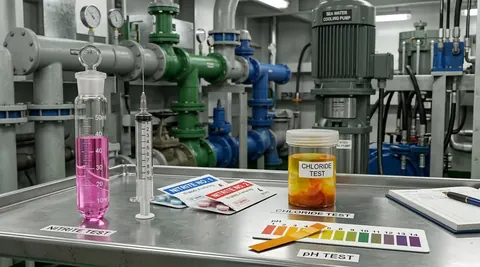
Every marine engineer who has stood watch on the bottom platform knows the morning routine. After checking your main engine stuffing box drains, feeling the scavenger air relief valves, and dipping the scavenge space drain tanks, you head over to the water testing bench on the workshop flat.
Closed-loop central cooling systems and main engine jacket water circuits run at temperatures between 75°C and 90°C. In that thermal operating band, untreated water turns aggressive. Oxygen attack, electrolytic galvanic cells between dissimilar metals (cast iron liners, steel jackets, bronze valves, and copper pipes), scale crystallization, and cavitation erosion will eat away cylinder liner landing faces in months.
Maintaining cooling water within OEM specifications (such as MAN B&W, WinGD / Wärtsilä, Yanmar, and Daihatsu) requires consistent quality control. Testing your cooling water daily using standardized marine water test kits—such as Wilhelmsen Ships Service (Unitor) Water Proof, Drew Marine, or Nalfleet—is the frontline defense against engine damage.
Here is the exact step-by-step procedure used by seafarers to sample, test, and calculate Nitrite, Chloride, and pH levels, along with practical troubleshooting for abnormal readings.
1. Step-by-Step Sampling Protocol
Before opening test kit boxes or handling tablets, your sample collection technique must be disciplined. Testing contaminated or stagnant water produces misleading numbers that lead to incorrect chemical dosing.
┌─────────────────────────────────────────────────────────────────────────┐
│                     COOLING WATER SAMPLING SEQUENCE                     │
└─────────────────────────────────────────────────────────────────────────┘
                                     │
                                     ▼
 1. Always Sample from the Same Dedicated Point
    (Circulating pump discharge or main engine outlet manifold before cooler)
                                     │
                                     ▼
 2. Flush the Sample Cock Thoroughly (15–30 Seconds)
    (Dislodges stagnant rust, scale flakes, and sediment from branch pipe)
                                     │
                                     ▼
 3. Rinse the Sample Bottle with Sample Water (2–3 Times)
    (Eliminates chemical residue from previous tests)
                                     │
                                     ▼
 4. Cool the Water Sample to Room Temperature (20°C–25°C)
    (Hot 85°C jacket water degrades test reagents and skews pH readings)
Important Watchkeeping Rule:
Always take your cooling water sample from the exact same location in the circuit every single day—ideally from the circulating pump discharge or the engine outlet manifold before the heat exchanger. Allow the sample cock to flow for at least 15 to 30 seconds into a bucket before filling your bottle. This flushes stagnant branch piping and clears out accumulated sediment, providing a representative sample of circulating water.
2. Nitrite Test (Corrosion Inhibitor Reserve)
Why Nitrite Matters
Most merchant ships use sodium nitrite-based chemical treatments (such as Unitor Rocor NB Liquid, Wilhelmsen Dieselguard NB, or Drew Liquidew). Nitrite (NO₂⁻) is an anodic inhibitor. It reacts with bare iron on cylinder liners, cylinder heads, and engine blocks to form a microscopically thin, self-healing passivating film of gamma-ferric oxide (γ-Fe₂O₃).
If nitrite falls below minimum threshold limits, the passivating film becomes incomplete, concentrating galvanic attack on exposed spots and causing severe localized pitting.
Passivating Reaction:
Fe²⁺ + 2NO₂⁻ + 2OH⁻  ⟶  γ-Fe₂O₃ (Passivating Film) + 2NO + H₂O
┌─────────────────────────────────────────────────────────────────────────┐
│ NITRITE TEST WORKFLOW (5 mL SAMPLE) │
└─────────────────────────────────────────────────────────────────────────┘
[5 mL Engine Water] + [45 mL Distilled Water] ──> Total 50 mL Volume
│
▼
Add 2 × Nitrite No. 1 Tablets
(Shake to disintegrate ──> Sample turns milky white)
│
▼
Add Nitrite No. 2 Tablets (One by One)
(Crush with glass rod, shake thoroughly)
│
▼
Titrate until Permanent Pink Appears
(Pink color must persist for at least 60 seconds)Step-by-Step Nitrite Testing Procedure
- Draw the Sample: Using the clean plastic syringe provided in the test kit, draw exactly 5 mL of cooled engine cooling water.
- Transfer and Dilute: Empty the 5 mL into the calibrated 50 mL shaker container. Add clean distilled or demineralized water (drawn fresh from your vessel’s fresh water generator) to bring the total volume up to the 50 mL mark.
- Add Conditioning Reagent (Nitrite No. 1): Add two Nitrite No. 1 tablets. Shake the container vigorously to disintegrate them. The sample will turn a cloudy, milky white color. This creates the acidic buffer necessary for titration.
- Titrate with Nitrite No. 2: Add one Nitrite No. 2 tablet. Crush the tablet against the container bottom using the plastic stirring rod, or cap and shake until dissolved.
- Observe Color Change: Continue adding Nitrite No. 2 tablets one at a time, crushing and dissolving each tablet thoroughly before adding the next.
- Identify Endpoint: Stop titration when the solution transitions from white/clear to a distinct pink color that persists for at least 1 full minute.
Calculation & Typical Limits
Nitrite concentration is measured in parts per million (ppm NO₂⁻) based on tablet consumption:
Nitrite (ppm NO₂⁻) = Number of Nitrite No. 2 Tablets × 180- Worked Example: If your test solution turns permanently pink after adding the 9th tablet:
Nitrite = 9 × 180 = 1,620 ppm NO₂⁻ - Control Band: Standard OEM and chemical supplier control limits generally fall between 1,000 ppm and 2,400 ppm NO₂⁻ (with some high-output 2-stroke engines specifying 1,500 to 2,500 ppm).
- Logging: Record the resulting value in your vessel’s digital chemical log (e.g., Wilhelmsen Water Proof) or engine room chemical log sheet.
3. Chloride Test (Seawater Ingress Detection)
Why Chloride Matters
Seawater contains approximately 19,000 ppm of chloride (Cl⁻). In contrast, closed-loop engine cooling water should remain almost free of chloride (typically below 50 ppm). Chloride ions penetrate and destroy the passive oxide protective layer, setting off pitting corrosion and stress corrosion cracking across cylinder liners and cooler plates.
A rising chloride count in your jacket water is an unmistakable signal that seawater is leaking into your freshwater cooling circuit.
┌─────────────────────────────────────────────────────────────────────────┐
│                   CHLORIDE TEST WORKFLOW (50 mL SAMPLE)                 │
└─────────────────────────────────────────────────────────────────────────┘
                        50 mL Neat Engine Water
                        (Filled directly to 50 mL mark)
                                 │
                                 ▼
                     Add 1 × Chloride Tablet
                     (Crush with rod ──> Solution turns yellow)
                                 │
                                 ▼
                     Add Chloride Tablets (One by One)
                     (Allow time for each tablet to dissolve)
                                 │
                                 ▼
                     Titrate until Permanent Orange-Brown
                     (Yellow transitions to a brick-red / orange-brown)
Step-by-Step Chloride Testing Procedure
- Measure Undiluted Sample: Fill the clean 50 mL shaker container with 50 mL of neat engine cooling water directly to the line (do not dilute with distilled water).
- Add First Chloride Tablet: Add one Chloride tablet to the water. Crush with the stirring rod and shake until completely disintegrated. If chlorides are present, the sample will turn yellow.
- Continue Tablet Titration: Add subsequent Chloride tablets one at a time. Shake and crush each tablet, allowing sufficient time for the reagent to dissolve and react before introducing the next tablet.
- Identify Endpoint: Watch for the transition where the bright yellow color shifts to a permanent orange-brown (brick-red) hue.
Calculation & Action Thresholds
Chloride concentration in parts per million (ppm Cl⁻) is determined by:
Chloride (ppm Cl⁻) = (Number of Tablets Added × 20) - 20- Worked Example: If the sample changes from yellow to permanent orange-brown on the 4th tablet:
Chloride = (4 × 20) - 20 = 80 - 20 = 60 ppm Cl⁻ - If only 1 tablet is required to produce an immediate orange-brown color:
Chloride = (1 × 20) - 20 = 0 ppm Cl⁻ - Normal Operating Limit: < 50 ppm Cl⁻.
- Alarm / Investigation Threshold: > 50 ppm Cl⁻ demands immediate tracing of coolers; > 100 ppm Cl⁻ requires immediate isolation of leaking heat exchangers, partial water dump, and fresh water replenishment.
4. pH Test (Alkalinity & Acid Attack Prevention)
Why pH Matters
The passivating iron oxide film generated by nitrite inhibitors is stable only in an alkaline environment. If cooling water turns neutral or acidic (pH < 8.0), the nitrite cannot protect the metal and rapid acidic corrosion occurs.
Conversely, if pH exceeds 10.0 to 10.5, the water becomes excessively caustic, which can dissolve solder joints, damage non-ferrous components (such as copper piping and bronze pump wear rings), and cause elastomer seal degradation on cylinder liner O-rings.
Acidic Corrosion Zone       Stable Passivating Zone       Caustic Attack Zone
0 ─── 1 ─── 2 ─── 3 ─── 4 ─── 5 ─── 6 ─── 7 ─── 8 ───[8.5 ─── 9.5]─── 10 ─── 11 ─── 12 ─── 13 ─── 14
[Passivating film breaks down, severe pitting]    [TARGET OPERATING BAND]    [Seal damage, caustic attack]
Step-by-Step pH Testing Procedure
- Prepare the Sample: Pour approximately 30 mL of cooled cooling water into the test vial.
- Immerse Indicator Strip: Take one fresh pH indicator test strip (multi-color zone strip) from its sealed container. Dip the test strip into the water so that all color indicator zones are completely immersed.
- Hold for 60 Seconds: Keep the strip submerged in the water for exactly 1 minute to permit full color development.
- Compare and Read: Withdraw the strip, gently shake off excess liquid droplets, and immediately align the colored pads against the calibrated color comparator chart on the strip container.
- Target Range: Normal operating pH for standard nitrite-treated marine diesel engines is 8.5 to 9.5 (some engine builders approve up to 10.0).
5. Summary Table: Engine Cooling Water Control Limits
| Parameter | Standard Target Band | Testing Frequency | Critical Warning Limit | Primary Failure Mechanism |
|---|---|---|---|---|
| Nitrite (NO₂⁻) | 1,000 – 2,400 ppm | Daily | < 1,000 ppm (or > 3,000 ppm) | Breakdown of passivating film; rapid pitting on liner landing faces and head jackets. |
| Chloride (Cl⁻) | < 50 ppm | Daily | > 50 ppm (Alert) > 100 ppm (Action) | Seawater ingress causing breakdown of protective oxide layer and pitting attack. |
| pH | 8.5 – 9.5 | Daily | < 8.3 (or > 10.5) | Acidic attack on cast iron (<8.3) or caustic leaching of seals, gaskets, and bronze fittings (>10.5). |
| Hardness (CaCO₃) | < 100 ppm (0–5°dH) | Weekly / Top-up | > 180 ppm | Calcium/magnesium scale precipitation on cylinder liner hot spots, leading to thermal cracks. |
6. Practical Engine-Room Troubleshooting & Corrective Actions
When your daily chemical log throws an out-of-spec number, understanding the physical cause in the engine room allows you to take corrective action before machinery suffers.
┌────────────────────────────────────────────────────────────────────────┐
│             ABNORMAL COOLING WATER READINGS & ROOT CAUSES              │
└────────────────────────────────────────────────────────────────────────┘

 [ Low Nitrite (< 1000 ppm) ]
   ├── Cause A: High makeup water consumption (hidden leaks at pump seals,
   │            expansion tank overflow, or liner O-rings).
   ├── Cause B: Nitrite consumed by bacterial contamination (denitrifying bacteria).
   └── Remedy:  Check expansion tank level trends. Dose chemical inhibitor via
                dosing pot according to product dosing charts.

 [ High Chlorides (> 50 ppm) ]
   ├── Cause A: Central plate heat exchanger titanium plate perforation or
   │            degraded nitrile/EPDM gasket.
   ├── Cause B: Fresh water generator (evaporator) condenser tube leak.
   ├── Cause C: Raw seawater bunkered or transferred into technical water tank.
   └── Remedy:  Isolate suspect cooler. Pressure test with freshwater. Carry out
                partial system blowdown and refill with distilled water.

 [ Low pH (< 8.0) ]
   ├── Cause A: Exhaust gas blowing past cracked cylinder head, cracked liner,
   │            or defective exhaust valve housing seal into cooling jacket.
   └── Remedy:  Check expansion tank vent for exhaust odor and bubbling. Test each
                cylinder indicator cock. Perform cylinder head gas leakage check.
1. What to Do When Nitrite Drops Rapidly
- Gradual Drop: Nitrite is slowly consumed over time as it repairs the protective oxide layer. If your reading slips below 1,200 ppm, calculate the required chemical top-up using the maker’s dosage chart (e.g., typically 1.5 to 2.5 liters of inhibitor per metric ton of cooling system volume to raise nitrite by 1,000 ppm) and dose it through the chemical dosing pot on the expansion tank circuit.
- Sudden Drop with Constant Level: If the expansion tank level remains steady but nitrite plummets over 48 hours, inspect for biological contamination (denitrifying bacteria that feed on nitrite and reduce it to ammonia or nitrogen gas). Water will often take on a sour or fishy odor. Biocide treatment and a system drain and flush may be required.
- Sudden Drop with Frequent Expansion Tank Makeup: If you are continually adding fresh water to the expansion tank, you are diluting the chemical reserve. Trace mechanical pump gland leaks, drain valve weeping, or jacket water leaks into scavenge spaces or exhaust uptakes.
2. What to Do When Chlorides Spike Above 50 ppm
Seawater has breached the closed loop. The most probable culprits on board are:
- Central Fresh Water Cooler Plate Pack: Seawater passes on one side of thin titanium plates and jacket water on the other. A perforated plate or pinched elastomer gasket will leak seawater into freshwater whenever seawater pressure exceeds freshwater pressure (or during shut-down when pressure differentials invert).
- Evaporator Condenser Tube Stack: In fresh water generators running on jacket heat, leaking condenser tubes allow distillate/brine carryover into the cooling stream.
- Auxiliary Cooler Leaks: Fuel valve cooling water coolers, turbocharger air coolers with raw water stages, or shaft alternator coolers.
Operational Recovery Procedure:
- Isolate the suspected cooler or switch over to the standby cooler pack.
- Carry out a partial blowdown of the cooling water expansion tank and circulating circuit to reduce chloride levels.
- Refill the system with pure technical distilled water produced by the ship’s evaporator.
- Re-dose corrosion inhibitor to restore nitrite to the 1,500–2,000 ppm range.
- Pressure test the isolated heat exchanger with freshwater at 3 to 4 bar to spot weeping plates or leaking tubes.
3. What to Do When pH Drops Sharply
A sudden drop in pH accompanied by blackening of the water is a classic maritime emergency: blow-by of combustion exhaust gases into the jacket water. Exhaust gases contain sulfur oxides (SOx) and carbon dioxide (CO₂), which dissolve into water to form sulfurous and carbonic acids, rapidly driving the pH down below 7.0.
- Check the cooling water expansion tank sight glass for gas bubbling and smell the atmospheric vent pipe for exhaust gas fumes.
- Isolate cylinders individually by checking cylinder head indicator cocks for water mist during turning gear routines, or by monitoring individual cylinder jacket water outlet temperature and pressure fluctuations.
7. How to Dose Chemicals Using the Engine Room Dosing Pot
Never dump concentrated cooling water chemicals directly into the expansion tank sight glass or top vent. Use the dedicated closed bypass dosing pot fitted near the circulating pumps or expansion tank return.
                 VENT COCK
                    │
                    ▼
              ┌─────┴─────┐
              │  FILL     │ <── Pour measured chemical inhibitor
              │  FUNNEL   │     (e.g., Unitor Rocor NB / Dieselguard)
              └─────┬─────┘
                    │
              [ISOLATION VALVE A]
                    │
                    ▼
             ┌─────────────┐
             │             │
             │   DOSING    │
[FROM PUMP]  │     POT     │   [TO PUMP SUCTION]
──────► [VALVE B]          [VALVE C] ──────►
             │  CYLINDER   │
             │             │
             └──────┬──────┘
                    │
              [DRAIN VALVE D]
                    │
                    ▼
               TO BILGE / TANK
Standard Operating Procedure for Chemical Dosing:
- Isolate the Pot: Close the pot inlet valve (Valve B) and pot outlet valve (Valve C).
- Drain Residual Water: Open the vent cock on top and open drain valve D at the bottom to drain clean residual water to the bilge tray.
- Close Drain: Close drain valve D.
- Pour Chemical: Open top isolation valve A and pour the calculated volume of corrosion inhibitor through the funnel into the dosing pot cylinder.
- Seal the Pot: Close top isolation valve A and close the vent cock tight.
- Cut into Circulation: Slowly open pot outlet valve C, then slowly crack open pot inlet valve B. Circulating water from the pump discharge will sweep through the pot, carrying the concentrated inhibitor into the suction line and dispersing it evenly through the entire engine circuit.
- Re-Test After 24 Hours: Allow the system to circulate for at least 12 to 24 hours under normal load before taking a fresh sample to confirm the new nitrite and pH steady state.
8. MEO Class 4 & Class 2 Oral Exam Viva Questions
During maritime competency oral examinations, surveyors frequently evaluate candidates on cooling water chemistry and troubleshooting. Below are common viva questions and practical model answers.
Question 1: “Why do we use distilled water instead of shore tap water or bunkered domestic water for jacket water makeup?”
Surveyor Expectation: Understanding scale formation and chloride hazards.
Model Answer:
“Shore tap water and bunkered domestic fresh water contain dissolved calcium and magnesium salts (temporary and permanent hardness) as well as municipal chloride levels. At normal engine jacket temperatures (80°C to 85°C), calcium and magnesium bicarbonates break down and precipitate as hard calcium carbonate scale onto hot cylinder liner and cylinder head surfaces. Scale has very low thermal conductivity—just 1 mm of scale restricts heat transfer by approximately 5%, causing localized hot spots, thermal stresses, and liner cracking. Furthermore, shore water can introduce unpredictable chlorides. We always use technical distilled water produced on board by the vacuum evaporator because it has zero hardness and negligible chlorides.”
Question 2: “What is the function of nitrite in jacket water, and why not use chromate treatments today?”
Surveyor Expectation: Passivation chemistry and maritime environmental regulations.
Model Answer:
“Nitrite acts as an anodic inhibitor. It reacts with exposed steel and cast iron to form a microscopic, passive gamma-ferric oxide (γ-Fe₂O₃) protective film that isolates the base metal from dissolved oxygen and water. Sodium chromate was historically an outstanding dual anodic-cathodic inhibitor, but it was banned under international health, safety, and environmental standards because hexavalent chromium is highly toxic, carcinogenic, and prohibited from marine discharge under MARPOL Annex III and port state regulations. Today, nitrite-borate formulations or organic acid technologies (OAT) are standard.”
Question 3: “During your morning watch, the jacket water chloride test requires 6 tablets to reach orange-brown. Yesterday it was 1 tablet. What does this mean, and what are your immediate actions?”
Surveyor Expectation: Fast calculation and practical emergency response.
Model Answer:
“With 6 tablets, the chloride concentration is:(6 × 20) - 20 = 100 ppm Cl⁻. Yesterday it was 0 ppm ((1 × 20) - 20 = 0 ppm). This sharp spike indicates active seawater contamination.
My immediate actions are:
- Report the abnormal reading to the Chief Engineer and 2nd Engineer.
- Inspect the central fresh water plate cooler and fresh water generator condenser. Compare seawater and freshwater operating pressures across the central cooler plates.
- Switch over to the standby central cooler plate pack if available, or isolate the freshwater generator to determine the leak source.
- Once isolated, carry out a controlled partial blowdown of the cooling circuit from the bottom drains and replenish with technical distilled water to lower the chloride level below 50 ppm.
- Dose chemical inhibitor to restore nitrite reserves, and pressure test the leaking cooler pack with freshwater to replace defective plates or failed gaskets.”
Question 4: “Why must you cool the jacket water sample before dipping the pH strip or adding tablets?”
Surveyor Expectation: Physical testing accuracy and chemistry principles.
Model Answer:
“Jacket water leaves the main engine at 80°C to 85°C. Hot water alters chemical equilibrium constants, accelerates evaporation in small test vials, and can degrade indicator dyes in tablet reagents, yielding a premature or inaccurate titration endpoint. For pH testing, indicator dyes on test strips are calibrated at 20°C to 25°C; testing hot water causes thermal discoloration of the paper substrate and provides a false pH reading. Letting the sample cool to ambient temperature in the engine control room ensures accurate, repeatable measurements.”
9. Watchkeeper’s Summary & Best Practices
Treating marine engine cooling water is not an optional chemistry chore—it is preventive maintenance that safeguards millions of dollars of main propulsion and auxiliary machinery.
- Test Daily at the Same Time: Consistency in sampling gives you reliable trend curves. A gradual change over five days reveals far more than a single erratic reading.
- Maintain Nitrite Reserves: Keep levels safely between 1,000 and 2,400 ppm NO₂⁻. Never let it dip below 1,000 ppm where partial passivation causes aggressive pitting.
- Act on Chlorides Immediately: Any chloride reading above 50 ppm is a sign of seawater ingress that must be found and stopped.
- Always Use Distilled Water: Never replenish jacket water expansion tanks with dock water, mineral water, or unevaporated domestic water.
- Log Accurately: Enter your results into software like Water Proof or your ship’s computerized maintenance system (PMS) so technical superintendents and shore chemical service engineers can verify dosages and trends.
Frequently Asked Questions
Discussion & Feedback
0Have a doubt, memory trick, or exam update? Share your insights with fellow mariners.